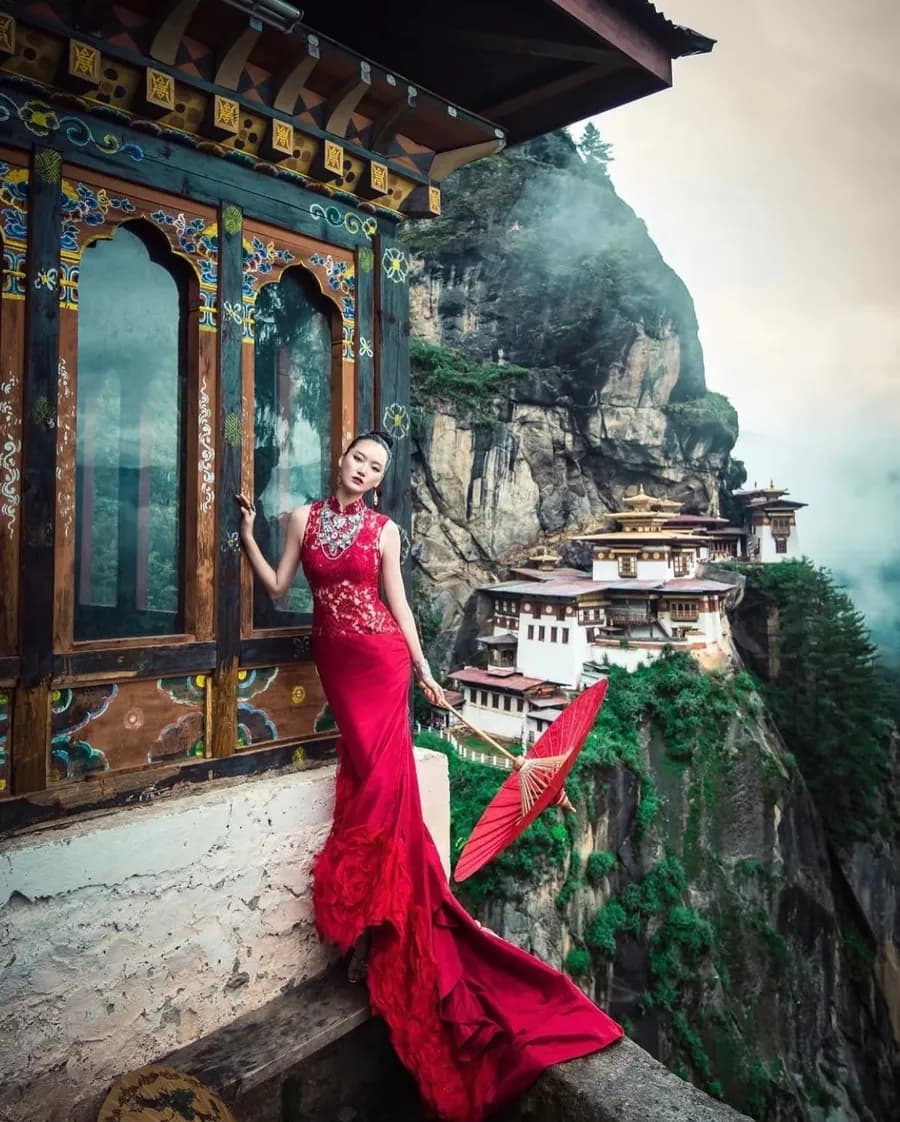
What to wear in dzongs, temples and monasteries
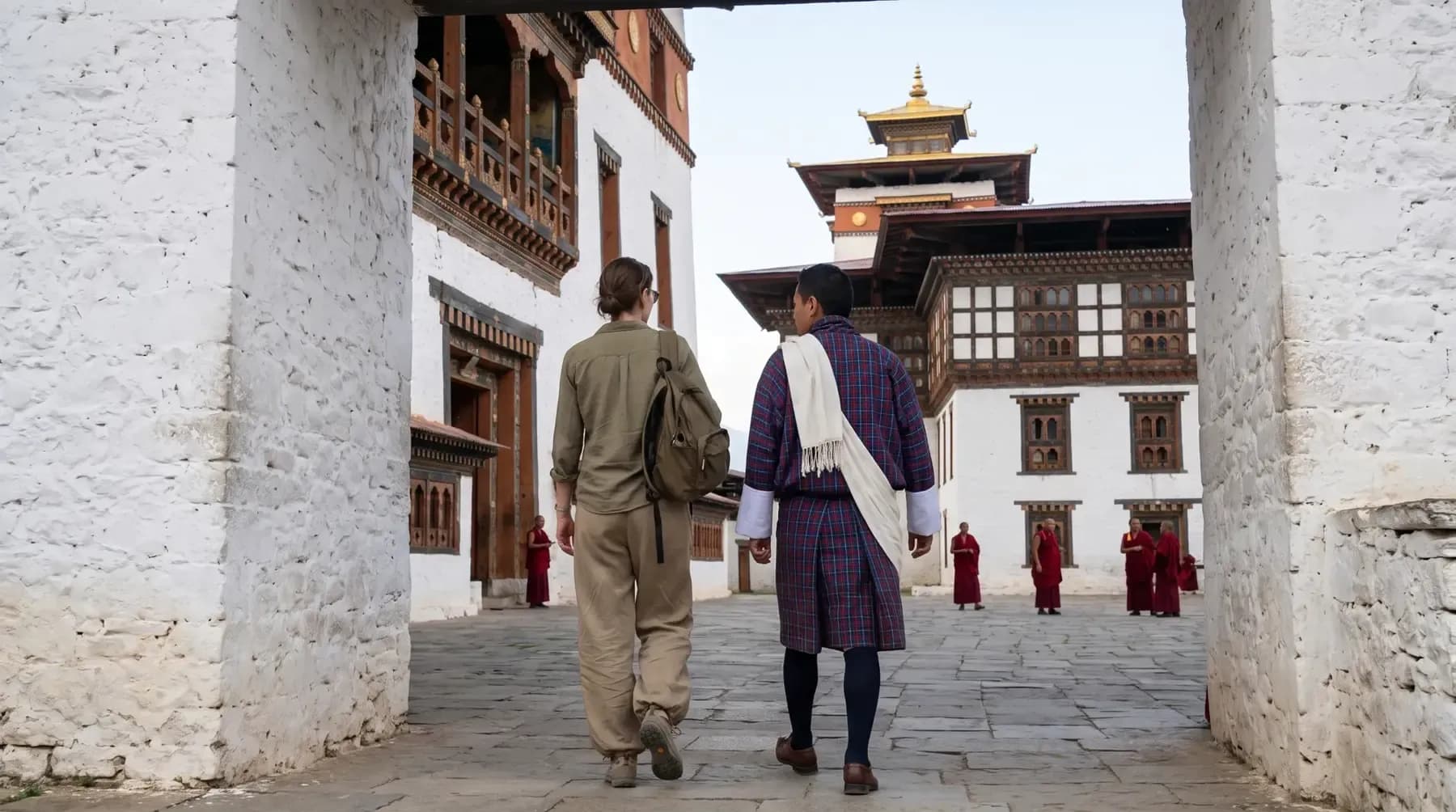
Dzongs, lhakhangs (temples) and monasteries aren't museums. Monks live and pray in them, and many dzongs are also working government offices. The caretakers at the gate do turn people away if they aren't dressed properly, and it's awkward for everyone when it happens. Your guide will remind you the evening before, but it's easiest to pack for it from the start.
| Wear | Avoid |
|---|---|
| Long trousers, or a skirt or dress below the knee (ankle-length is safest) | Shorts, short skirts, leggings on their own |
| A shirt with sleeves. A collar is safest; over a T-shirt, bring a light jacket or shawl | Sleeveless tops, low necklines, see-through fabric |
| Closed shoes that are easy to slip off | Flip-flops |
| Nothing on your head once you're inside | Hats, caps, sunglasses and umbrellas inside the buildings |
Away from religious sites, on hikes, in town and at your hotel, wear what you like, within reason. Bear in mind that Bhutanese people wear the gho (men) and kira (women) to school, to work and on any official visit, so you'll stand out more in shorts than you might expect. On sightseeing days, a pair of light trousers in your daypack solves everything.
What to wear in Bhutan, season by season
Bhutan's weather changes a lot with height. On one day you can drive from warm rice fields in Punakha (about 1,250 m) over a pass at 3,100 m where it's cold enough for a hat. So pack layers rather than one heavy coat, and keep a warm top in the car.
- Spring (March to May): light trousers and long-sleeved shirts for the day, a fleece or light down jacket for mornings and evenings, and a rain jacket from May.
- Summer (June to August): the monsoon. Quick-dry clothes, a proper rain jacket, and shoes that cope with mud. Days are warm and humid in the valleys.
- Autumn (September to November): the clearest weather. Daytime is mild, but nights in Paro, Thimphu and Bumthang get cold from October, so bring a warm jacket.
- Winter (December to February): sunny, dry days and freezing nights. A down jacket, thermal layers, a warm hat and gloves. Hotels have heaters, but old temples don't.
- All year: comfortable walking shoes with grip for the Tiger's Nest, sunglasses and sunscreen (the sun is strong at altitude), and one smarter outfit for a festival or a nice dinner.
Bhutan packing list
You don't need a big suitcase for Bhutan, just a few layers that work together. Most hotels do laundry, so a week's worth of clothes is plenty even for a longer trip.
The essentials
- Comfortable walking shoes with good grip, plus boots if you're trekking
- Light layers: T-shirts, long-sleeved shirts, a light jumper and long trousers
- A warm fleece, plus a down jacket from November to March
- A waterproof jacket or windbreaker
- Sun hat, sunglasses, sun cream and lip balm
- A universal plug adaptor and a power bank
- Your passport, visa approval and insurance documents
Health and toiletries
Bring any prescription medicines, motion-sickness tablets for the mountain roads, hand sanitiser, and insect repellent in summer. Pharmacies in Thimphu and Paro stock the basics; elsewhere they're small.
Plugs and power
Bhutan runs on 230 volts, with Type D, F and G sockets. A universal adaptor covers them all. Hotels have reliable power, but a power bank helps on long drives and treks.
Documents
- A passport valid for at least six months, with a blank page
- Copies of your passport and ID
- Your e-visa approval letter (or entry permit for Indian nationals)
- Travel insurance details
- Flight tickets and your tour confirmation
- Emergency contacts
What not to pack
- Heavy winter clothes in summer
- Formal evening wear: smart casual is fine in every hotel and restaurant
- Big bottles of toiletries, which you can buy in Thimphu and Paro
Inside a temple or dzong
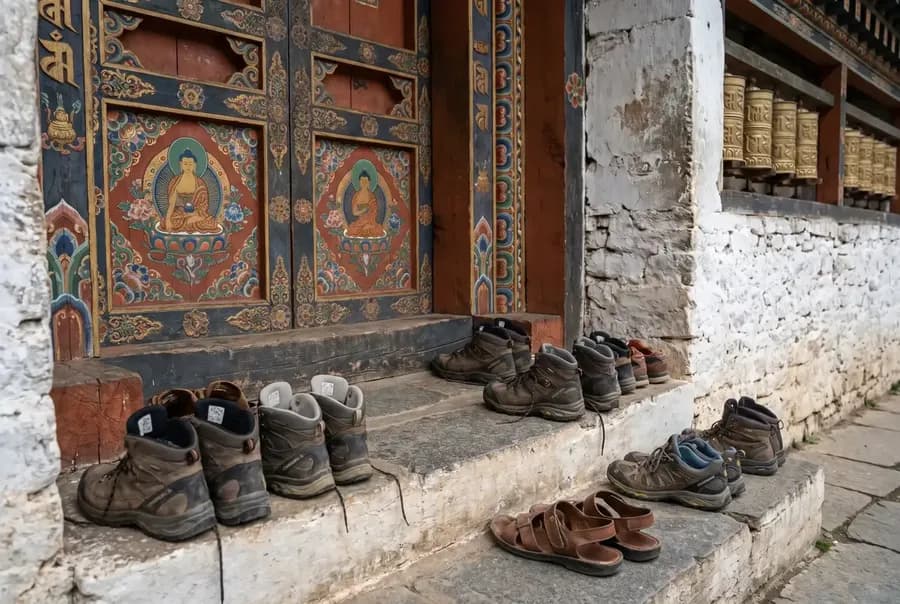
- Take your shoes off before going into a shrine room and leave them by the door. Socks are fine, and the floors can be cold.
- No photos or videos inside temples and shrine rooms. Courtyards and outside walls are usually fine, but ask your guide first.
- Walk clockwise around chortens, prayer wheels, temples and the inner courtyard of a dzong. Spin prayer wheels clockwise too.
- Don't point your feet at an altar or a lama, don't sit on cushions meant for monks, and don't touch statues or offerings.
- Offerings are welcome but never expected. A small note left on the altar is the usual way to do it.
- Keep your voice down, put your phone on silent and don't smoke anywhere near a religious site.
If a monk or caretaker offers you holy water, hold out your right hand cupped over your left, sip a little, and wipe the rest over your head. Your guide will show you. It's a blessing, and nobody minds if you get it slightly wrong.
Etiquette at a festival (Tshechu)
A Tshechu is a religious event first and a show second. Locals come in their best gho and kira, often brand new for the occasion, so dress a notch smarter than usual and follow the temple dress code in the dzong courtyard.
- Never walk across the dance ground, and don't stand in front of people sitting down to watch.
- No flash and no drones, and don't climb on walls for a better angle. A longer lens from the edge works best.
- The atsaras, masked clowns with wooden phalluses, will probably tease you or ask you for money as a joke. Play along. It's part of the fun.
- On the last morning of the Paro and Thimphu Tshechus, a giant thangka (the thongdrel) is unrolled before dawn. Get there early.
Driglam namzha: Bhutan's code of etiquette
Driglam namzha is Bhutan's traditional code of dress and behaviour. It asks Bhutanese people to wear the gho or kira in dzongs and government offices, with a ceremonial scarf over the shoulder: the kabney for men and the rachu for women. The colour shows rank. Most people wear white, senior officials wear other colours, and saffron is reserved for the King and the Je Khenpo, the chief abbot.
Visitors aren't expected to wear a kabney or rachu, and modest Western clothes are fine everywhere. You'll notice your guide put on a kabney before walking into a dzong, though. It's one of the small moments that shows you how seriously this is taken.
To learn what each piece of the gho and kira is called and how they're worn, read our guide to Bhutan's national dress.
Visiting a Bhutanese home
- Take your shoes off at the door, as you would at a temple.
- You'll be offered butter tea or sweet tea, and probably ara. It's polite to say “meshu meshu” (no, no) once or twice before accepting.
- Many farmhouses have a small altar room upstairs. If you're shown in, the same rules apply as in a temple.
- A small gift is kind but not necessary. Something from home, sweets for the children or fruit all go down well.
Everyday manners
- Say “Kuzuzangpo la” to say hello. Adding “la” to the end of a sentence makes it more polite.
- Give and receive things with your right hand, or with both hands for anything important.
- Speak respectfully about the royal family. The King and Queen are genuinely loved, and their photos are in almost every home and shop.
- Ask before photographing people, especially monks, and always in homes.
- Smoking in public places is banned. You can bring a small amount of tobacco for your own use and pay duty on it when you arrive.
- There's very little haggling in Bhutan. Prices in shops are usually fixed, and bargaining hard can come across as rude.
- Tipping isn't required, but it's usual to tip your guide and driver at the end of a trip if you were happy with them.
Packing for the season? See the best time to visit Bhutan and our Bhutan travel FAQ.
Read next
About the author
Lucky Dragon Tours & Treks · Licensed tour operator, Thimphu. Our Thimphu team plans private, tailor-made trips across Bhutan and writes from what we see on the road with our guests.
Published · last updated